EspLORE @ NanoLab Talk

Talk entitled: “Light Scattering and Emission from Hetero-structures” given by  Andrea Carlo Ferrari, Cambridge Graphene Centre, University of Cambridge UK When: Thursday 28th of march at 14.00 Where: Politecnico di Milano, Classroom C.I.1 Building 6 - Leonardo Campus Piazza leonardo da Vinci 32 Milan NanoLab Talks are organized at the Micro- and Nanostructured Materials Laboratory (NanoLab) at the Department of Energy of Politecnico di Milano (www.nanolab.polimi.it). The EspLORE@NanoLab Ta...
Read More
New paper published

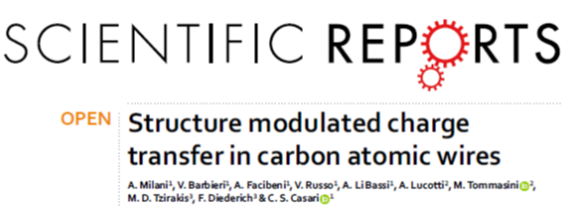
A new paper with EspLORE results has been published on Scientific Reports (Nature group). We report the observation of charge transfer modulated by the structure of the carbon wire. The work is a collaboration between the EspLORE team at Politecnico di Milano (Department of Energy and Department of Chemistry, Materials and Chemical Eng., "G. Natta") and the group of Prof. F. Diederich at ETH Zurich (Department of Chemistry and Applied Biosciences). A. Milani, V. Barbieri, A. Facibeni, V. Russ...
Read More

Opportunity for Marie Skłodowska-Curie Actions @EspLORE

A new opportunity for Marie Skłodowska-Curie Actions (MSCA) individual fellowship 2019 is open at the EspLORE project. Politecnico di Milano is launching a pilot Master Class (MSCA EF MASTER CLASS 2019 @ POLIMI) for potential applicants to the MSCA - European Individual Fellowship call 2019. Look for "Development of sp carbon nanostructures and nanomaterials" in the framework of the ERC EspLORE. The aim of the call is to attract and train young and talented researchers to successfully applying...
Read More

New PhD student @ EspLORE

We welcome on board Patrick Serafini as a new PhD student at the EsplORE team working on first principles calculations of sp-carbon nanostructures. He was born in 1994 in Teramo, Italy. He is a PhD student in Energy and Nuclear Science and Technology since 2019. He graduated magna cum laude in Materials Engineering and Nanotechnology in December 2018 with a thesis on  Density Functional Theory simulations of two-dimensional sp-sp2  carbon nanostructures. His interests are mainly focused o...
Read More

EspLORE @ IIT

We will be present at the Center for NanoScience and Technology CNST of the Italian Insitute of Technology IIT with a seminar about carbyne and carbon atomic wires. Seminar: “Linear carbon: from the quest of a new allotrope to nanotechnology” Monday 21st January, at 11:30 am in meeting room C at CNST of IIT Speaker: Carlo Casari
Read More

Graduations @ EspLORE – Winter 2018

Congratulations to new graduate students in Master of Science in Materials Engineering and Nanotechnology at Politecnico di Milano working on topics of the EspLORE project. Today 4 students got their Master Degree: Andrea Dalla Via graduated with a thesis entitled: Density Functional Theory simulations of Raman and UV-VIS spectra of carbon atom wires Riccardo Improta graduated with a thesis entitled: Scanning tunneling microscopy and Raman spectroscopy of carbon atom wires synthesized ...
Read More

new article on sp-carbon

We published a new paper discussing by numerical simualtions the capability to investigate sp-carbon structures by x-ray absorption techniques. This work is the results of a collaboration between EspLORE, University of Milan and University of Milan-Bicocca. This article is published on Materials (MDPI) and belongs to the Special Issue Density Functional Theory (DFT) Calculation of Materials Properties. Title: Fingerprints of sp1 Hybridized C in the Near-Edge X-ray Absorption Spectra of Su...
Read More

Special Issue “Recent Advances in sp-Carbon-Based Materials and Nanostructures”

The special issue on "Recent Advances in sp-Carbon-Based Materials and Nanostructures" is a  now open for submissions deadline for manuscript submissions: 30 June 2019 The aim of this Special Issue of Applied Sciences (ISSN 2076-3417) by MDPI publishing is to present the last achievements obtained in the research on sp-carbon-based materials (polyynes, cumulenes, linear carbon chains, carbon atomic wires) and related systems (hybrid sp–sp2 or sp–sp3 systems). Both experimental (synthes...
Read More